課程名稱︰普通物理學甲上
課程性質︰系內必帶
課程教師︰王立民
開課學院:工學院
開課系所︰土木工程學系
考試日期(年月日)︰98/11/12
考試時限(分鐘):110min
是否需發放獎勵金:是,謝謝
(如未明確表示,則不予發放)
試題 :
普通物理期中考(CH4~9)
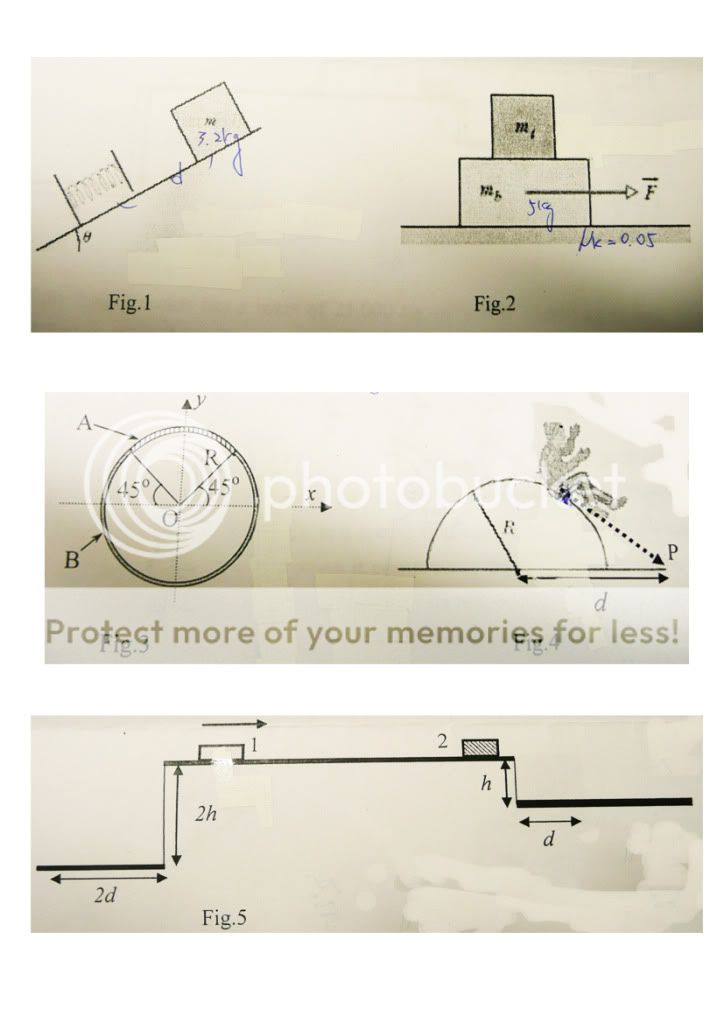
試題附圖:http://i814.photobucket.com/albums/zz65/kenyang0531/Untitled-2.jpg
1.In Fig. 1, a block of mass m=3.20 kg is released from rest on a frictionless
incline of angle θ=30°. Below the block is a spring that can be compressed
2.0 cm by 8.62 N. The block momentarily stops when it compresses the spring
by 20.0 cm. (a) How far does the block move down the incline from its rest
position to this stopping point? (b) What is the speed of the block just as
it touches the spring? (c) What are the distance between the point of the
first block-spring contact and the point where the block's speed is greatest,
and (d) the greatest spped in (c)?(20%)
2.The potential energy of a diatomic molecule is given by
U=-A/r+B/r^2, A and B >0
where r is the seperation of the two atoms of the molecule. This potential
energy is associated with the force that binds the two atoms together. (a)
Find the equilibrium seperation-that is, the distance between the atoms at
which the force on each atom is zero. Is the force repulsive (the atoms are
pushed apart) or attractive (they are pulled together) if their seperation is
(b) smaller and (c) larger than the equilibrium seperation?(15%)
3.A block of mass mt=4.0 kg is put on top of a block of mass mb=5.0 kg. Between
the two blocks, the coefficient of static friction is 0.25, and the
coefficient os the kinetic friction is 0.15. The assembly os blocks is now
placed on a horizontal table with a kinetic-friction coefficient of 0.05.
(Fig. 2). Find the magnitudes of (a) the maximum horizontal force that can be
applied to the lower block so that the blocks will move together and (b) the
resulting accerlation of the blocks.(20%)
4.A ring was broken and seperated into two parts, A and B as shown in Fig. 3.
Find the positions of center of mass for A and B.(10%)
5.A boy is initially seated on the top of a hemispherical ice mound of radius R
. He begins to slide down the ice, with a negligible initial speed (Fig. 4).
Approximate the ice as being frictionless. (a) At what height does the boy
lose contact with the ice?(5%) (b) Find the distance d between the landing
position (point P) and the center of hemispherical ice.(10%, total 15%)
6.In Fig. 5, puck 1 of mass m1 = 0.20 kg is sent sliding across a frictionless
lab bench, undergoing a one dimensional elastic collision with stationary
puck 2. Puck 2 lands a distance d from the base of the bench, while puck 1
lands a distance 2d from the base of the bench as shown in Fig. 5. What is
the mass of puck 2?(10%)
7.A fully fueled rocket has a mass of 21,000 kg, of which 15,000 kg is fuel.
The burned fuel is spewed out the rear at a rate R = 190 kg/s with a speed of
2800 m/s relative to the rocket. If the rocket is fired vertically upward,
calculate: (a) the thrust of the rocket and (b) its velosity at burnout.
Ignore air resistance and the accerlation due to gravity.(10%)
--
※ 發信站: 批踢踢實業坊(ptt.cc)
◆ From: 118.168.86.16